Good craftsmanship should serve the well-being of people, be sustainable, save resources and protect the environment.
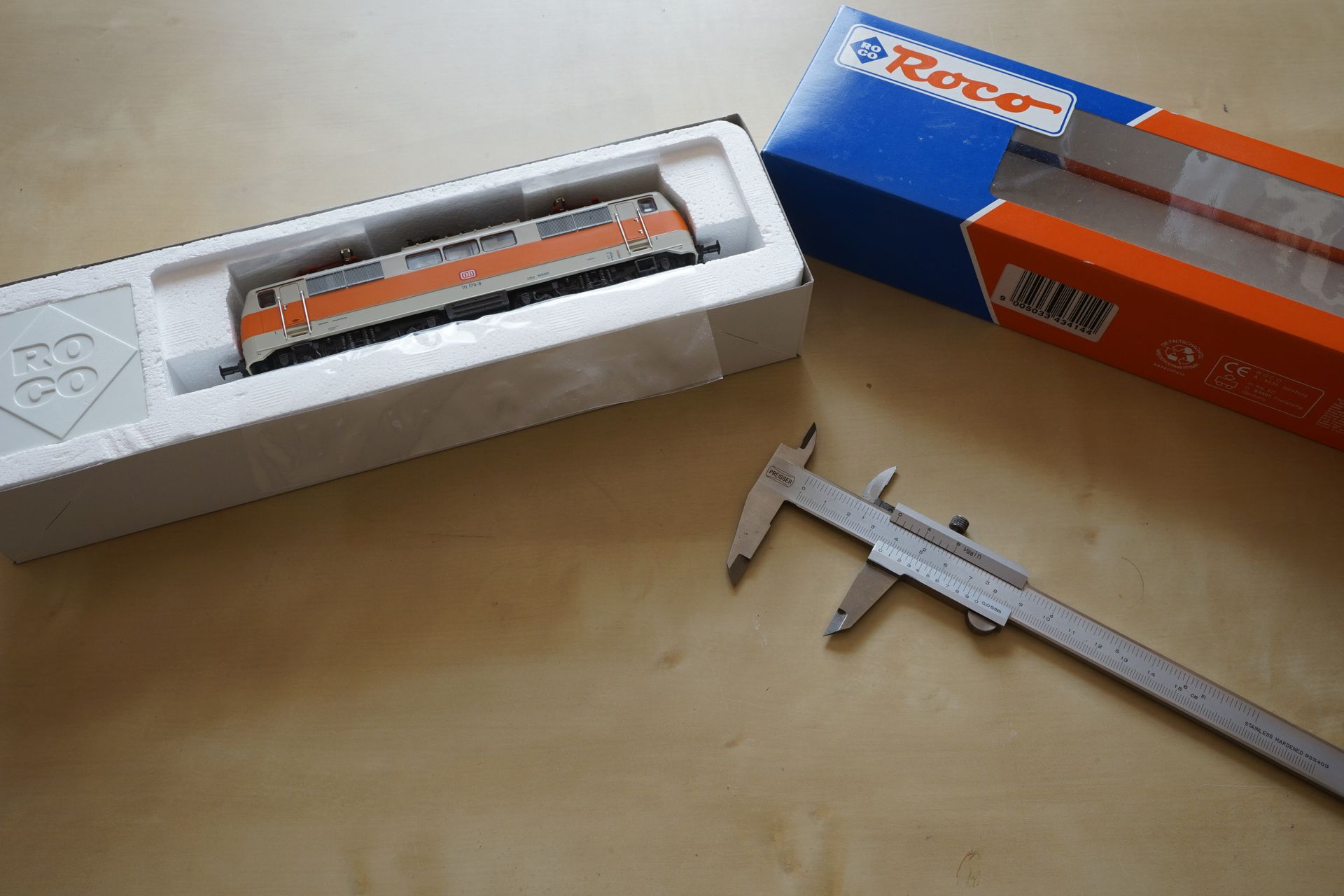
In the model railway depot, locomotives from various manufacturers in the toy industry are worked on. The work is deliberately designed to be as similar to that in real railway depots. This means that screwing, milling, turning, drilling, sawing, filing, adjusting, assembling, testing, etc. are carried out here.
I work on locomotives in model scale HO.
As a trained toolmaker, I attach great importance to precision and stable constructions.
Locomotives and vehicles are completely dismantled and rebuilt at the model railway depot in Frankfurt. Many parts are thrown out and replaced with new designs.
I think about each model and put my own ideas on paper; I make my own calculations for engine speed and gear ratios and carry out tests to see if everything works the way I imagine it.
Only when I am convinced of the model myself do I offer it to customers for purchase.
Through my own experience as a model railroader and also through my training as a mechanic, I know the weak points of a construction.
First and foremost, I am concerned with the driving characteristics of the model. Locomotives have to run. They should not be able to cover utopian routes. My locomotives have to be able to handle gradients and train lengths that actually existed in reality.
That is why I do not go beyond gradients of 3.5% and also not beyond train lengths of more than 13 IC carriages.
The locomotives will receive a high-quality bell-armature motor, a new gearbox, a new locomotive frame, new LED lamps and a locomotive decoder, as well as the largest possible loudspeaker and a new circuit board and wiring.
The construction has to be stable and low-maintenance because I don't want to walk around with the oil can and the grease pot every week. That's why I use a combination of brass and metal, because brass alloys have very good rolling and sliding properties and therefore also certain emergency running properties, which hopefully you don't need but should be there. So far I can only say positive things about it. I only use high-quality materials that are also used in tool and machine construction. Almost all parts are screwed together and are interchangeable and precisely manufactured.
The idea for the model railway depot came from my passion for railways, my training as a mechanic, observations on the track and my own experiences in the model railway sector.
Ultimately, it was also my anger and disappointment when I bought vehicles that simply didn't work as hoped and it turned out that the plastic gears were worn out and not installed precisely, or the locomotive squeaked because the bearings were made of plastic and, for whatever reason, huge motors were installed. And then there was the annoyance when plastic parts broke because they were clicked together.
The list could go on and there will certainly never be fully developed designs, but in the spirit of sustainability I would like to try to offer products that last a long time and that the model railroader enjoys.
pricing
Pricing a product like this is of course difficult because you can't see the technology used, even though that's what matters.
You can't get something like this for free. My locomotives are unique and custom-made.
The price for a locomotive is in the four-digit range.
Who is this for?
The model railway depot is for people who enjoy rebuilding models or buying them. It is aimed at people who don't want a standard model. If you can get by with standard models, you've come to the wrong place. In the model railway depot, vehicles are worked on with different tools. If you're afraid of using milling cutters, drills, grinding pins, files, saws, pliers, etc. to work on a model, then you'd better move on.
My models have a high-quality interior that is not immediately noticeable from the outside. What use is a beautiful model that doesn't drive well?
For me, model railway depot means that changes are made to the vehicle, individually for each locomotive. This creates models that look natural, just like in real everyday operation.
Like everything in life, it is a matter of taste.
The model railway depot does not accept any third-party locomotives. Locomotives from our own stock are offered.
Why?
Experience shows that a lot can go wrong during a conversion and the model would have to be replaced. That is simply not affordable.
I'm not taking any risks either.
The development will never be finished and completed. New ideas and production options are constantly being added, which can then lead to a change in the model.
But one thing always remains.
The vehicle must be sustainable and stable as far as the parts of the model railway depot are concerned. I have no influence on the parts from suppliers, e.g. electronic components. The vehicle should also be low-maintenance and easy to repair if something breaks, which can certainly happen with wearing parts. The vehicle is very complex and malfunctions can occur, which I try to rule out through very extensive testing phases. However, this is not 100% possible. There is always a residual risk.
The locomotive wants to be driven. It is a long-distance runner and not for the display case.